
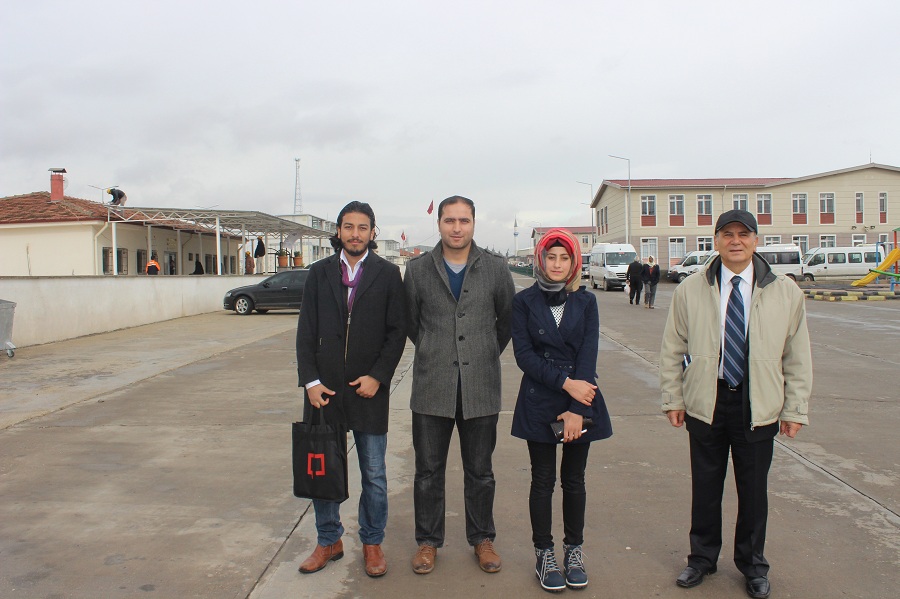
AFAD Kilis-Öncüpınar Accommodation Facility
Inspection Report[1] Program Participants
Assoc. Prof. Dr. Ali Serdar ERDURMAZ (Hasan Kalyoncu University, Department Head of Political Science and International Relations)
Asst. Prof. Dr. Bilal ÇIPLAK (Hasan Kalyoncu University, Deputy Department Head of Political Science and International Relations)
Mustafa ŞAHİN (Hasan Kalyoncu University, Student in the Department of Political Science and International Relations).
Rawdanoor CUMHA (Hasan Kalyoncu University, Student in the Department of Political Science and International Relations)
Site Visited
AFAD Kilis-Öncüpınar Accommodation Facility (November 26, 2014)
Introduction
The Middle East Research Center organized a field visit on November 26, 2014, with the aim of examining and evaluating the Kilis Accommodation Facility. The first aspect that drew our attention was the approach adopted by Turkish authorities, who refer to Syrian refugees as “guests” and to the AFAD (Disaster and Emergency Management Authority) camps housing refugees as “temporary accommodation facilities.” Both the concept of “guest” and that of “temporary accommodation facility” reflect the perspective of Turkish authorities toward Syrian refugees. The implicit message conveyed by this framing is: “Syrian guests will stay in Türkiye only temporarily and will return home once the situation in Syria normalizes.” For instance, one of the banners displayed at the entrance of the Öncüpınar camp, reading “You are our brothers; in the homeland of your brothers, you are in your own home,” is quite illustrative in this regard. While on the one hand the brotherhood between Türkiye and Syria is emphasized, on the other hand it is simultaneously acknowledged by the Turkish state that Syrians are guests (in a temporary status) in the homes of their Turkish brothers.
However, the situation has evolved, and the arguments are shifting. The belief that Syrian guests have become permanent residents in Türkiye is growing both among official authorities and among the general public. For example, the Camp Coordinator and Deputy Governor of Kilis, Mr. Ulaş Akhan, who is referred to as the Camp Governor, expressed his impression that Syrians are now permanent residents of Türkiye. He also spoke of the importance of integrating Syrian guests into the communities in which they live, noting that Türkiye’s human resources are insufficient for this purpose and that educated Syrian youth with language skills could make significant contributions to this process. This view has also begun to spread among Syrians themselves. For instance, the couple Ahmet and Delal, whom we visited as guests in their home within the camp, stated that they could no longer return to Syria since their home and city had been destroyed. A public opinion survey conducted in August 2013 by Kilis 7 Aralık University also shows that a large proportion of Syrian guests are now inclined to remain in Türkiye. According to this survey conducted in Kilis, only 52% of Syrian guests wish to return home immediately after the end of the war. [2] The civil war that has led to the destruction of cities across Syria gives strong signals that this proportion will rise considerably higher.
Program Flow and Observations
We gathered at Hasan Kalyoncu University in Gaziantep on Wednesday morning at 8:30 a.m. and arrived at the Kilis Öncüpınar Temporary Accommodation Facility approximately one hour later, at 9:20 a.m. Before reaching the camp, we encountered a long queue of trucks transporting goods to Syria. Despite the war, destruction, and all other security risks, we witnessed that commercial relations were still ongoing. However, as could be seen from the open-top trucks, the majority of the cargo consisted of construction equipment and materials. At the very entrance to the camp, security personnel asked questions about the purpose of our visit and our identification details. Since our visit was being conducted with the permission of the Governor, the necessary procedures were completed and we were granted entry. We were required to leave our identity cards and vehicle registration documents at the security point. At the camp gate, our research team was welcomed by our student of Syrian origin, Rawdanoor Cuma, who is still living in the camp with her family. As we walked inward, the sentence displayed at the entrance gate — “You are our brothers; in the homeland of your brothers, you are in your own home” — caught our attention. This sentence was, in fact, a reflection of the situation Türkiye currently finds itself in: a demonstration of our desire for Syrians to be temporary, even though we know they will become permanent.
As we toured the camp, photographs of prominent visitors to the camp and their justifiably positive remarks about it displayed on the walls drew our attention. After a brief walk, at around 9:50 a.m., we were received by Mr. Savaş Kök, the AFAD official responsible for the Kilis Öncüpınar Accommodation Facility. He then shared some details about the camp with us. The Kilis Öncüpınar Container City was established on an area of 315,000 m2 and consists of 2,065 containers. Currently, 13,300 Syrian guests are living in the city. Among these individuals are many who have lost family members and whose relatives are still fighting. In addition, a playground area of 5,335 m2 has been established within the camp.
The container city offers vocational training courses for men and women, daycare services for children, internet services, television viewing rooms, 3 large supermarkets, schools, as well as laundry washing and drying rooms. With security measures also in mind, 14 watchtowers and 98 security cameras have been installed. In addition, the container city is staffed by 23 police officers, 12 gendarmerie personnel, and 140 private security officers. In terms of health services, the health center within the container city operates 2 ambulances, 8 doctors (4 of whom are Arabic-speaking), and 8 health personnel. A total of 4,183 Syrian children and young people receive education in 80 classrooms located within the container city. Of these, 333 are high school-level students, while the remainder are continuing students at the middle and primary school levels. Although referred to as a mosque, two large mosques have also been made available for the use of the guests.
At around 10:20 a.m., we met with Ms. Seval Irmak, the psychologist of Zeytin Nursery. Ms. Seval spoke about the socio-psychological services provided to children who have lost family members and fled the war in the nurseries. During our conversation, we formed a strong impression that there is a specialized team providing such services within the camp. Ms. Seval’s psychological expertise and her experience with Syrian guest children make her particularly distinguished in this field. She then proceeded to show us the nursery classrooms. Zeytin Nursery currently has 385 students enrolled. In addition to psychological support, these students are also taught the Turkish language. Furthermore, care has been taken to ensure that the policies implemented within the camp are consistent with Syrian culture. For example, in the camp, female and male students attend separate schools. The cleanliness of the nursery and the seriousness of the teachers caught our attention. We told Ms. Seval that she could pursue a master’s or doctoral degree at our university. We also asked whether she and her colleagues would be willing to come to our university as speakers. Ms. Seval indicated that she would be open to cooperation, provided the necessary permissions were obtained from camp authorities.
At around 10:40 a.m., we met with Mr. Seyfettin, Principal of El-Selam Girls’ Middle School. He provided us with information about education for female students in the container city. The girls’ middle school currently has 479 female students enrolled. Mr. Seyfettin told us that the residents of the camp leave the camp during the day to participate in working life and return to the camp in the evenings. He then spoke about the absence and importance of projects aimed at informing such workers about Türkiye’s legal framework. He also said that learning the Turkish language was essential. According to Mr. Seyfettin, Syrian guests appear to be permanent residents of Türkiye. He therefore emphasized the importance of integration projects targeting them. At around 11:00 a.m., we met with Mr. Mehmet Ali, Principal of El-Selam Boys’ Middle School. He told us that the boys’ middle school currently has 510 students enrolled.
At around 11:20 a.m., we visited the Social Facilities building within the camp, which serves the adult residents. We examined the mosaic portraits, a joint work by Syrian-born artists Mr. Ferit and Ms. Büşra. We would like to exhibit these artworks at our university.
At around 11:50 a.m., we visited the family of Ahmet and Delal Muhammed, who reside in the facility. The family’s daughter, Nur, welcomed our team with a poem in Turkish. Mr. Ahmet came from the city of Idlib in Syria. He had been working as a construction craftsman in Syria. He said he is currently not employed in any job. The prefabricated home consists of two small rooms and a bathroom-toilet area. One room serves as the parents’ bedroom and the other functions as both the children’s room and the kitchen. While the structure may be suitable for emergency situations, it is not entirely conducive to long-term living. The camp management, having recognized this, has already prepared a project to construct two-story and considerably more comfortable prefabricated houses. Despite the difficult circumstances they find themselves in, the couple Ahmet and Delal displayed a wonderful example of hospitality toward us.
12:30 – 14:00 Lunch break.
At 14:00, we attended a panel organized by Kilis 7 Aralık University’s Faculty of Economics and Administrative Sciences and the Kilis İŞKUR Provincial Directorate, at which Deputy Governor Ulaş Akhan (responsible for Kilis Accommodation Facilities) was the speaker. Mr. Ulaş delivered his remarks on Arab–Turkish cooperation and the future of Syria. The speaker addressed the importance of language proficiency in this context through the following statements. He noted that humanitarian aid organizations are operating very intensively in the region under current circumstances, emphasizing that there is a pressing need for qualified human resources in this rapidly growing sector. The Deputy Governor, who stated that the need for personnel fluent in English, Turkish, and Arabic is considerable, explained that this need creates attractive employment opportunities for both Syrians and Turks. He therefore highlighted the importance of the employment that would be generated by learning local languages in addition to English.
Following the panel, at around 3:00 p.m., we visited Kilis Deputy Governor Ulaş Akhan and Prof. Dr. H. Mustafa Paksoy, Dean of the Faculty of Economics and Administrative Sciences at Kilis 7 Aralık University. We provided Mr. Ulaş with information about the Hasan Kalyoncu Middle East Research Center. Mr. Ulaş mentioned that there is an available area within the camp and stated that we could conduct our work in that area. He expressed his wishes to meet with us again.
We then exchanged views with Prof. Dr. Mustafa Paksoy, Dean of the Faculty of Economics and Administrative Sciences at Kilis 7 Aralık University. We proposed cooperation on the projects of our Middle East Research Center. The Dean responded positively to our project and we expressed the will to establish cooperation.
Conclusions and Recommendations
In conclusion, our team conducted a highly productive and positive research and observation visit. In general, an excellent degree of order and discipline was evident throughout the camp. Furthermore, a very substantial infrastructure has been established to address the social, religious, psychological, shelter, nutrition, and educational needs of the guests living in the camp. This picture is seen as a reflection, in foreign policy, of the sensitivity of the Turkish state’s approach to human rights and the prevention of victimization of women and children.
In interviews conducted with camp residents, it was learned that the camp’s rules are implemented with rigor, and it was observed that a certain degree of public order has been maintained. Although complaints were occasionally voiced about the strictness of the rules, it was observed that everyone was experiencing a certain and visible degree of satisfaction. This order represents a considerable achievement in terms of enabling nearly 14,000 people to coexist peacefully.
Based on the data obtained during our camp visit, it was determined that there are several areas suitable for academic research. For example, most of the education and psychological support programs in the camp are implemented for children. The matter of directing this support toward women who have lost their spouses in the conflict, so that they can provide a strong family cohesion and support their children, is a topic that should be carefully examined.
Another issue concerns the need to ensure that the people living in the camp are gradually integrated into Turkish society. Given the reality that the adults residing here will not be able to return to Syria in the short to medium term, they need to be educated about our country’s customs and traditions, legal system, and social and human relations. Turkish language instruction, seminars introducing the legal system, and similar training programs could be delivered more effectively with the assistance of regional universities.
In particular, however, educated Syrian youth could make a significant contribution to educating Syrian society. The difficulty that exists here, however, is that most educated Syrians have migrated to Western countries — or indeed to western provinces — and that there is no knowledge base regarding the numbers, areas of expertise, and language proficiencies of those who have remained. For this reason, research must urgently be conducted to build a database and identify the existing potential. Subsequently, programs should be prepared to educate Syrian youth, teach them Turkish, and to enable Syrian experts (such as doctors, teachers, etc.) to become organized. It is assessed that our university could take a pioneering role in this area with its existing infrastructure.
As a result of the meetings held with provincial governorship officials, the camp management expressed its desire and inclination to cooperate with our universities. Camp Governor Mr. Ulaş Akhan emphasized that an area within the camp has been set aside for universities to come and conduct their work, and that this facility could be utilized by our university. It appears feasible for our university to carry out an active engagement in this area within the framework of a project to be developed.
In our meetings with Mr. Mustafa Aksoy, Dean of the Faculty of Business Administration at Kilis 7 Aralık University, we learned that they had conducted a demographic study on Syrians living in Kilis and had compiled it into a report. We reached an agreement to cooperate on conducting the same study on Syrians who have settled in the city of Gaziantep. We believe that putting this into practice in the shortest possible time, through an organizational effort to be undertaken with the approval of our university, and having it published as a university publication and distributed to senior officials and relevant authorities, would be a significant activity in terms of establishing a reference source.
Finally, despite all security risks, our courageous truck drivers and business people continue to transport and send goods to Syria. This subject alone is a topic worthy of research. For example, topics such as how truck drivers or business people navigate organizations like ISIS and the PKK, how they gain access to areas under Assad’s control, and how they regulate their relations with the Free Syrian Army are entirely unknown areas and subjects of great curiosity. There is therefore an urgent need for research on these matters. The resulting research, while possessing intelligence value, would also be a highly significant contribution in terms of public diplomacy and humanitarian relations, conveying the experiences of the region regarding how commercial and other individual humanitarian relations are conducted in times and places of conflict.
[1] We extend our deepest gratitude to the camp officials who opened their doors and hearts to us during our camp visit, first and foremost to Camp Coordinator and Kilis Deputy Governor Mr. Ulaş Akhan. We also wish to express our sincere thanks to Prof. Dr. Mustafa Paksoy, Dean of the Faculty of Economics and Administrative Sciences at Kilis 7 Aralık University, for the attention and interest he showed us. It is a great honor for us to have made their acquaintance.
[2] Mustafa Paksoy, A Research Report on the Socio-Economic Problems of Syrians Who Have Fled the Civil War and Are Living in Kilis, Kilis 7 Aralık University, Middle East Studies Application and Research Center, August 2013.