
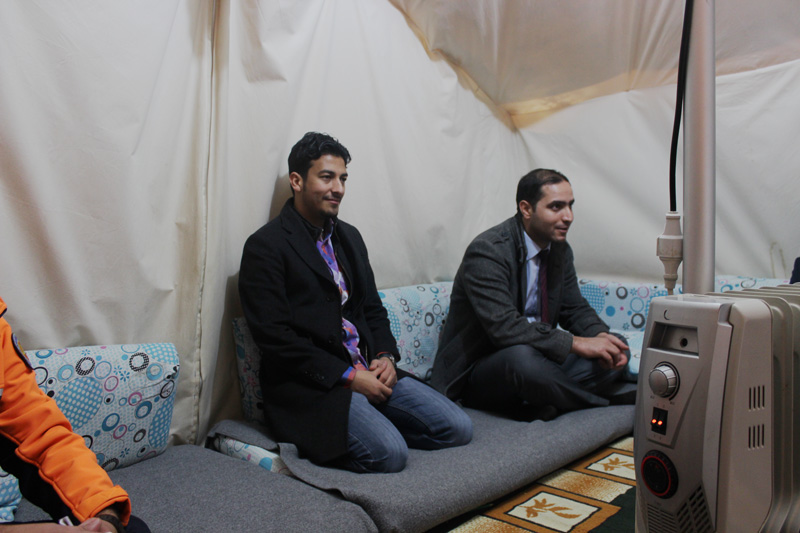
On December 24, 2014, a visit to the Karkamış Syrian Guests Tent City was conducted by Hasan Kalyoncu University’s Middle East Research Center, carried out by Asst. Prof. Dr. Bilal ÇIPLAK, Research Asst. Ömer Ertuğrul MERAL, Research Asst. Özgür Osman DEMİR, and Mustafa ŞAHİN. The findings are reflected in this report.
This visit, organized by the Center, is the third visit conducted following those to the container towns of Kilis and Nizip.
Asst. Prof. Dr. Bilal Çıplak
Research Asst. Ömer Ertuğrul Meral
Research Asst. Özgür Osman Demir
Physical, Psychological, and Sociological Conditions in the Tent City
The Karkamış Tent City was established on August 8, 2012, on an area of 220,000 m2, located 6.5 km from the Karkamış district center, approximately 74 km from the center of Gaziantep, and approximately 3 km from the border, on the edge of the Karkamış dam. As of the date of the visit, 7,687 people were residing in the tent city. Approximately 4,000 of these individuals are under the age of 18. There are 1,668 tents in the tent city. Based on these figures, the average number of persons per tent is 4.6. Given that the tents have a designated capacity of 4 persons, the high proportion of children under the age of 18 does not make tent usage excessively difficult.
The transportation needs of residents are met through shuttle services. These services enable day trips to meet needs outside the tent city.
A representative (muhtar) has been elected from each neighborhood within the tent city to assist shelter management primarily in the areas of population control, education, and service distribution. Announcements are made through these representatives, and information regarding infrastructure deficiencies in the tent city is relayed for immediate intervention. As an example, during a representatives’ meeting held in the course of our visit, muhtars were briefed on fire safety measures, and information was exchanged regarding the electrical issues in the neighborhoods.
Healthcare services in the tent city are provided through a field hospital established at the entrance. The hospital includes 3 general practitioners, 3 emergency medical technicians, 1 midwife, 1 ambulance, 3 nurses, 1 environmental health technician, 1 pharmacy, and 3 health information clerks. Within this structure, an average of 120 Syrian guests can receive healthcare services daily. In critical cases, patients may be referred to the Nizip State Hospital.
Primary, secondary, and high school education within the shelter is provided in classrooms established with the support of UNICEF and the district governorship. Syrian guests who are qualified teachers also contribute to the educational process. Education is conducted in separate classes for boys and girls, reflecting a continuation of the educational structure in Syria. There are a total of 52 teachers and 2,391 students in the schools. Due to the high density, three academic sessions are conducted simultaneously. The recently introduced container units are intended to alleviate this congestion. A library is also planned to be established under current conditions. Turkish language instruction is provided to both teachers and students by TÖMER.
Security in the tent city is maintained by a total of 105 personnel and 36 security cameras. Public order issues within the shelter are immediately reported to the responsible police officer and the necessary procedures are initiated. This approach has been followed for public order incidents over the past six months. Security issues encountered across the camp include early-age marriage, stabbing, physical violence including flogging, and similar incidents. In this context, various training programs on Syrian culture may be offered to law enforcement personnel in order to guide their approach to such issues. This is because certain actions that are considered offenses or misdemeanors in our culture are not regarded as crimes in Syrian culture. For this reason, such training is of importance for ensuring healthy communication between security personnel and guests. For instance, marriage under the age of 18, polygamy, and the flogging of children who commit offenses, though common in Syrian society, are considered crimes under our laws.
There is one market within the tent city. Residents receive 85 TL per person per month. Guests may use this income at the market or wherever they choose. Market prices are determined with the approval of the tent city director, based on prices in the surrounding districts. In addition to this financial assistance, daily necessities such as clothing and cleaning supplies are provided by the administration.
Courses in arts and crafts, sewing and embroidery, and painting are organized for adult women through adult education centers. Alongside these courses, health classes on topics such as women’s health and childcare are also provided. Through these courses, women at the shelter are engaged in social activities. However, this is quite limited for men. The majority of working-age men residing at the shelter are employed in the district centers of Nizip and Karkamış; however, those who are not working have virtually no social activities available to them. The sports facilities intended to channel young people’s energy productively are considered insufficient. It is necessary to organize activities specifically for the male population of the tent city. Orientation opportunities for those who are disadvantaged in terms of university education (including those who had to abandon their university studies due to the war) could be explored. In this regard, Syrian students enrolled at our university could be assigned as mentors.
From a sustainability perspective, it has been observed that no plan has been formulated by the administrators. Given that similar shelter facilities worldwide remain open for an average of 8–9 years, arrangements and projects aimed at the gradual integration of camp residents into society could be developed. For example, a program involving one year of legal training and Turkish language instruction in the tent city, followed by two years of integration into employment, housing, and Turkish society, could be implemented. As language training is of particular importance, the learning of Turkish by Syrian guests should be encouraged.
Despite having fled the war, residents of the center are continuously exposed to the sounds of conflict due to the camp’s proximity to the border, which perpetuates their traumatic circumstances. In this context, trauma groups could be formed and group counseling sessions could be implemented to enhance the subjective well-being of the guests. Furthermore, since camp personnel may also be negatively affected psychologically by the post-war situation they witness, group counseling sessions should similarly be made available to staff.
Conclusion
In general, it has been observed that residents of the center are satisfied with their conditions. Correspondingly, it was also observed during tent visits that the conditions within the tent city offer a certain level of comfort. The tents are structurally suitable for winter conditions, and electricity and heating equipment have been provided by the relevant units.
As conveyed by the social worker on duty, those who arrived from Syria do not experience a stark contrast with their previous way of life. This is because the majority had been living in rural areas prior to the war and had maintained continuous commercial relations with the Karkamış region, so they do not feel entirely unfamiliar. The main challenge lies in adapting to certain camp rules, a situation that has gradually improved over time through educational activities.
As Hasan Kalyoncu University’s Middle East Research Center, we extend our gratitude to Tent City Director Mr. Fuat ÇELİK, the AFAD personnel in charge, and Social Worker Zöhre GÜNGÖRDÜ for their kind hospitality during the visit.